
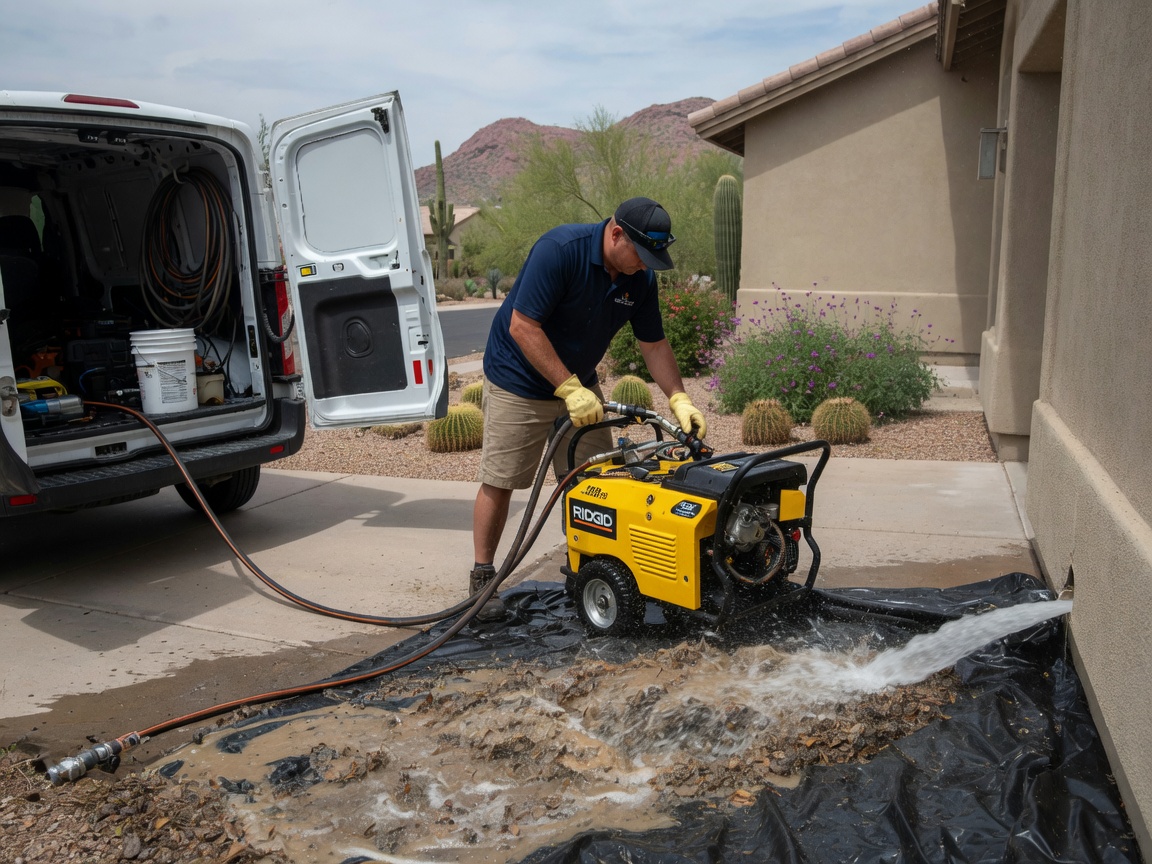
Scottsdale’s hard desert water leaves heavy mineral scale inside cast-iron and galvanized lines common in Old Town Scottsdale and Gainey Ranch homes built before 1990. Hydrojetting at 3,500–4,000 PSI strips that buildup without chemicals that can damage older pipe joints. In Maricopa County, where summer temperatures regularly exceed 110 degrees, grease from kitchen lines hardens quickly once it cools, creating stubborn blockages that snaking alone rarely clears completely.
Terrain around Camelback Mountain and Troon North often means longer sewer runs with multiple cleanout locations and elevation changes. A hydrojet crew must map each cleanout and choose the correct nozzle angle to avoid pushing debris into the main rather than flushing it out. Paradise Valley and Tempe properties frequently share laterals with neighbors, so pressure must be controlled to prevent backflow into adjacent homes during the jetting process.
After jetting, technicians run a camera to confirm the line is clear and note any remaining cracks or offsets that could re-clog within months. Homeowners in Desert Mountain and McCormick Ranch are advised to schedule annual preventive jetting because the alkaline soil and low rainfall concentrate minerals faster than in milder climates.
Technician insight
In Scottsdale the thing that catches most people out with hydrojet service is how fast mineral scale returns in homes built on the older side of McCormick Ranch. The alkaline water and 110-degree summers bake deposits back onto the pipe walls within 18 months, so one-time jetting rarely solves the problem long term.
McCormick Ranch main line backup
A homeowner in McCormick Ranch reported slow drains after heavy monsoon rain. Camera inspection showed compacted scale and grease 60 feet from the cleanout. Hydrojetting at 3,800 PSI cleared the line completely and restored full flow to the street connection.
Hydrojet Service Services We Offer
✓Residential Drain Line Hydro Jetting
Clears kitchen, bath and laundry lines in Scottsdale homes using targeted high-pressure nozzles sized for 1.5- to 4-inch pipes.
✓Sewer Main Jetting
Removes roots, scale and sludge from the main sewer lateral running from the house to the street connection in Maricopa County neighborhoods.
✓Kitchen Grease Line Cleaning
Breaks down hardened cooking grease that solidifies rapidly in Scottsdale’s hot climate before it reaches the main sewer.
✓Root Intrusion Hydro Jetting
Cuts through tree roots invading sewer lines common around older properties near Scottsdale Fashion Square and Taliesin West.
✓Commercial Hydro Jet Service
Handles larger-diameter lines and higher-volume waste at Scottsdale restaurants and retail centers with 4,000 PSI equipment.
Hydrojet Service Cost in Scottsdale, AZ
| Service | Typical Range | What Affects It |
|---|---|---|
| Kitchen or bath branch line | $250–$450 | Shorter runs under 40 feet with standard access |
| Main sewer lateral jetting | $450–$750 | Includes camera and up to 100 feet |
| Root cutting add-on | $150–$300 | Required when roots are present |
| Commercial line (4-inch+) | $600–$1,200 | Larger diameter and higher volume |
Ranges are typical for Scottsdale, AZ and confirmed with an exact written quote before any work starts.
How it works
- 1
Locate And Expose Cleanouts
Technicians identify all accessible cleanouts on the property, including yard and roof lines common in Scottsdale homes.
- 2
Camera Inspection
A pre-jet camera run maps the blockage location, pipe material and any offsets before water pressure is applied.
- 3
Select Nozzle And Pressure
The correct jetting head and PSI setting are chosen based on pipe age and debris type found in the initial inspection.
- 4
Jet And Flush
High-pressure water is run from the farthest cleanout toward the street, flushing debris out while monitoring flow at each access point.
- 5
Final Camera Verification
A post-service camera confirms the line is clear and documents any remaining defects for the homeowner.
Pricing
Residential hydrojet jobs in Scottsdale typically range $300–$800 depending on line length, access difficulty and debris volume.