
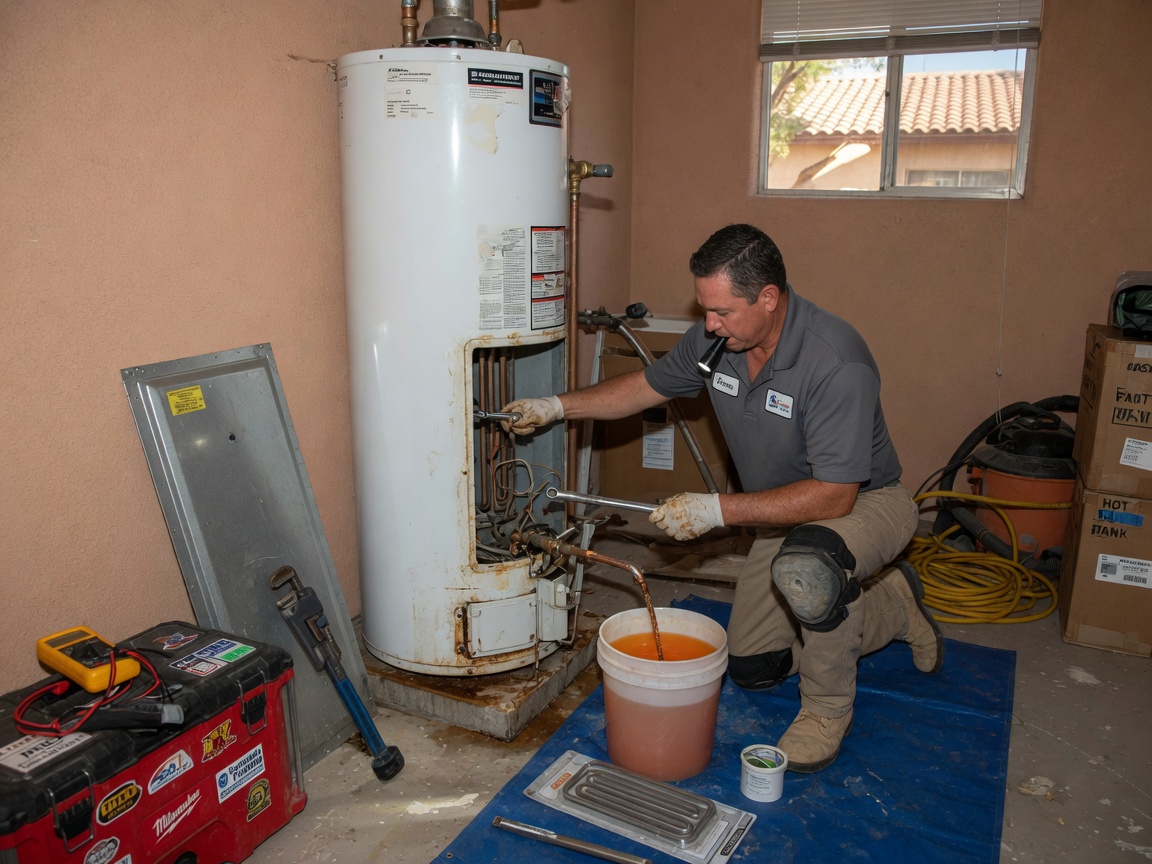
Scottsdale homes built from the 1970s through the 2000s in neighborhoods such as McCormick Ranch and Gainey Ranch commonly have 50- to 80-gallon tanks that accumulate desert sediment quickly. Hard water from the Salt River Project supply leaves calcium and mineral scale on heating elements and anode rods, shortening service life and raising energy use. Technicians routinely remove the lower element, flush the tank through the drain valve, and check the dip tube for breakage before restoring hot water.
Gas models in older Old Town Scottsdale properties often show failing thermocouple or gas control valves after years of exposure to extreme summer heat that accelerates wear on rubber seals. Electric units in newer Troon North and Desert Mountain builds can fail when upper and lower elements short from scale buildup. Technicians isolate power at the breaker, test resistance with a multimeter, and replace only the failed component when the tank itself remains sound.
Tankless units installed in Paradise Valley and Tempe border homes require descaling every 12 to 18 months because the same mineral load that affects tanks also coats heat exchangers. Ignoring the annual flush leads to flow sensor errors and overheating shutdowns during peak winter demand. Repair calls frequently include replacing the inlet filter screen and recalibrating temperature settings to match the home’s fixture count.
All work follows Maricopa County permitting rules for gas line pressure tests and venting clearances. Technicians carry replacement elements, valves, and anode rods on the truck to complete most repairs in one visit rather than leaving homeowners without hot water overnight.
Technician insight
In Scottsdale the thing that catches most people out with water heater repair is how fast desert sediment packs the bottom of tanks in McCormick Ranch and Gainey Ranch homes; homeowners wait until the lower element fails completely instead of flushing every other year, which turns a simple element swap into a full drain and clean job.
Lower Element Failure in McCormick Ranch
A homeowner in McCormick Ranch reported no hot water on a Tuesday morning. Inspection showed the lower element shorted from scale and the tank held six inches of sediment. The technician flushed the tank, replaced the element and thermostat, and confirmed 120-degree output at every fixture before leaving.
Water Heater Repair Services We Offer
✓Electric Element Repairs
Replace burned-out upper or lower heating elements and test thermostats on electric tanks common in Scottsdale homes.
✓Gas Control Valve Repairs
Diagnose and replace faulty gas valves, thermocouples, and pilot assemblies on natural gas water heaters throughout Maricopa County.
✓Sediment Flush and Cleaning
Power flush mineral buildup from tanks and tankless heat exchangers to restore efficiency in hard-water Scottsdale neighborhoods.
✓Thermostat Replacement
Install new upper and lower thermostats to restore accurate temperature control on electric units serving Old Town and McCormick Ranch homes.
✓Tankless Descaling Service
Perform vinegar or citric acid flush on tankless units to remove scale from heat exchangers in Gainey Ranch and Desert Mountain properties.
✓Anode Rod Inspection and Replacement
Check and swap magnesium or aluminum anode rods to extend tank life in homes drawing from Scottsdale’s mineral-rich supply.
Water Heater Repair Cost in Scottsdale, AZ
| Service | Typical Range | What Affects It |
|---|---|---|
| Electric element replacement | $225–$450 | Varies by element type and whether upper, lower, or both need replacement. |
| Gas valve or thermocouple service | $275–$550 | Higher when venting or gas line adjustments are needed. |
| Full tank flush and anode rod | $175–$325 | Includes drain valve clearing and rod inspection. |
| Tankless descaling | $250–$400 | Includes filter cleaning and flow sensor check. |
Ranges are typical for Scottsdale, AZ and confirmed with an exact written quote before any work starts.
How it works
- 1
Initial Assessment
Arrive on site, confirm power or gas supply, and drain a small amount of water to check sediment level and temperature.
- 2
Component Testing
Use multimeter and manometer to test elements, thermostats, gas valves, and venting before any disassembly.
- 3
Targeted Repair
Replace only the failed part, flush the tank or exchanger, and verify operation under load.
- 4
Final Safety Check
Re-pressurize, test for leaks, confirm combustion air and venting meet code, then restore full service.
Pricing
Upfront quotes provided before any work begins; final price depends on parts required and access conditions.